Customer care stopped being measured channel by channel
A customer messages your business on WhatsApp on a Saturday night, calls on Monday to confirm a detail, and on Tuesday visits your website to check on their order. To them, it's one conversation. For most businesses, it's three separate systems that don't talk to each other — and the customer ends up repeating the same thing three times.
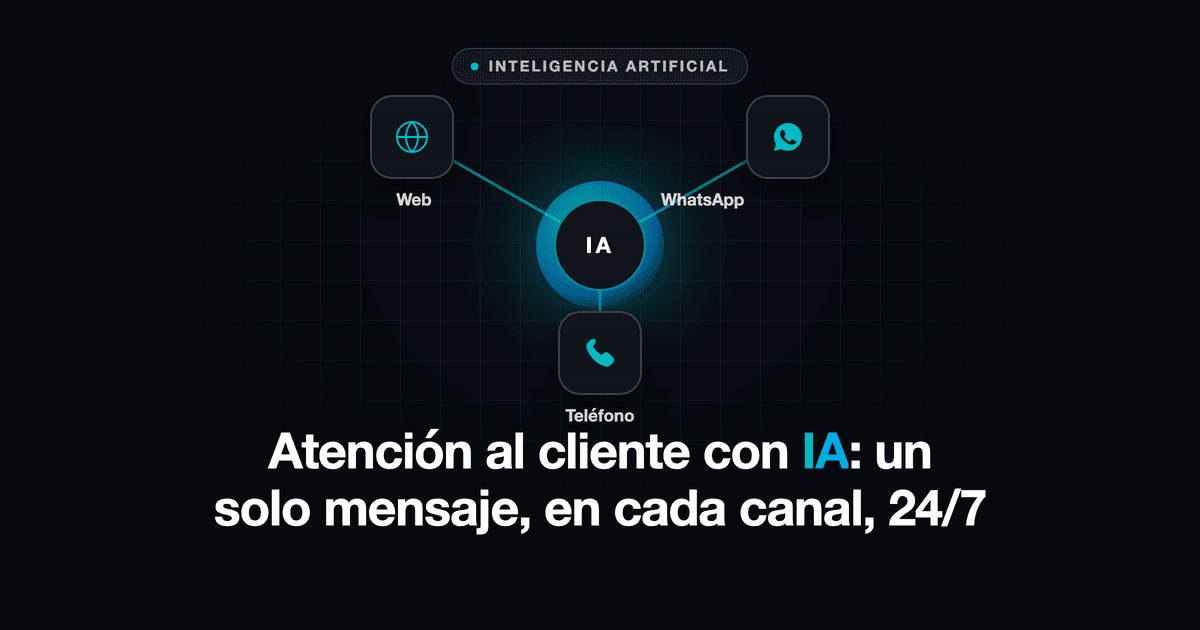
That's what changes when AI customer care is treated as an experience, not a channel. It's not about having one chatbot on the site and a different bot on WhatsApp. It's one AI system handling all three channels at once, with the same information, the same tone, and the same memory of what's already been said — no matter where the customer comes in.
Pre-sale, sale and post-sale: the full experience, not just the chat
Thinking of "customer service" as a chat that answers questions is only a small part of the picture. A customer's real relationship with your business has three distinct moments, and AI can support all three:
- Pre-sale. Before deciding, the customer asks about stock, pricing, location, business hours, which professionals or specialties you cover, available appointment slots, which coverage or insurance you accept. It's the stage where the most inquiries get lost simply because nobody answered in time.
- Sale. During the purchase decision, the AI confirms orders, coordinates appointments, collects deposits when needed, sends confirmation by email and calendar, and resolves last-minute doubts before the customer backs out for lack of a response.
- Post-sale. After the purchase, it's still the same system answering follow-up questions, support requests, changes or returns — not a new channel the customer has to learn to use.
The point isn't that AI "also" works for post-sale. It's that it treats all three stages as one continuous relationship, not three separate parts of the business with their own tools.
How an AI customer care agent actually gets built
It's not magic, and it's not a generic product you install and it just works. Building an agent that genuinely resolves things — not one that just repeats a script — follows a concrete process:
- Mapping real inquiries. Before writing a single line of configuration, you need to understand what a real customer of that specific business actually asks — not a generic FAQ list.
- Connecting to real business data. The agent needs to read real, up-to-date information: stock, calendar, rates, management system. Without this, no matter how sophisticated the AI is, it ends up making up answers or escalating everything.
- Training tone and brand voice. The agent responds in your business's voice, not a generic virtual-assistant style. This gets tuned with real conversation examples, not a single instruction.
- Defining when it hands off to a person. No well-built agent tries to resolve 100% on its own. What requires human judgment gets defined up front, and the handoff happens with the full conversation context already loaded.
- Testing with real conversations, not hypothetical ones. Behavior gets validated against concrete cases before launch, and keeps getting tuned with real usage afterward.
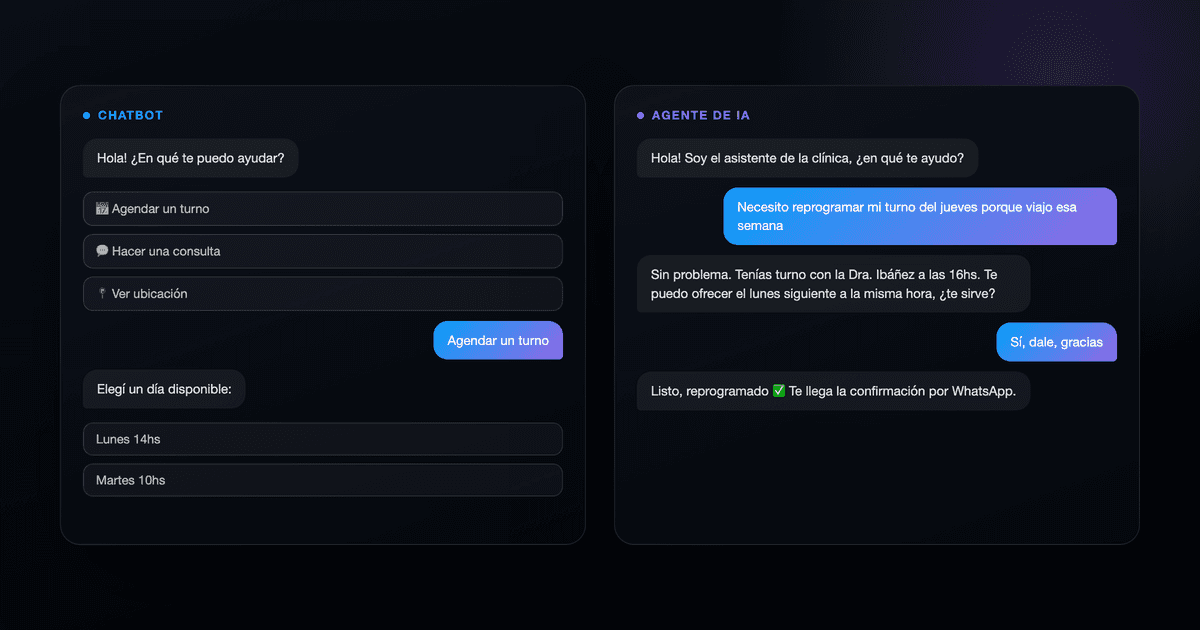
If you want the full technical breakdown of how a conversational agent works and how it differs from a fixed-flow chatbot, we cover it in AI agent for customer service: what it is, how it works, and when it's worth implementing.
Real omnichannel: one message for the whole world
Here's the difference that matters most and gets explained the least: omnichannel doesn't mean "being present" on several channels. It means it's the same AI answering on every one of them.
In practice, that means one system handles:
- The website, with a chat widget answering a visitor who hasn't decided to message on WhatsApp yet.
- WhatsApp, the highest-volume channel in Latin America, where customers are already used to handling every kind of task.
- Phone calls, with a voice agent that holds a real conversation — not a numbered menu of options, but a dialogue that understands what the customer says and responds accordingly.
What makes this work as one experience, instead of three similar-looking bots, is that all three channels share the same brain: the same knowledge base, the same tone, and the same history of that specific customer's conversation. If someone asked something over WhatsApp in the morning and calls in the afternoon, the agent already knows what it's about — it doesn't start from zero.
This also avoids a quiet problem many businesses don't even notice: the site chat says one thing, WhatsApp says something slightly different, and whoever answers the phone says a third version — because a different person or system handles each channel. With one AI system behind all three, there's a single message for the whole world, with no contradictions between one and the other.
What kind of business this works for
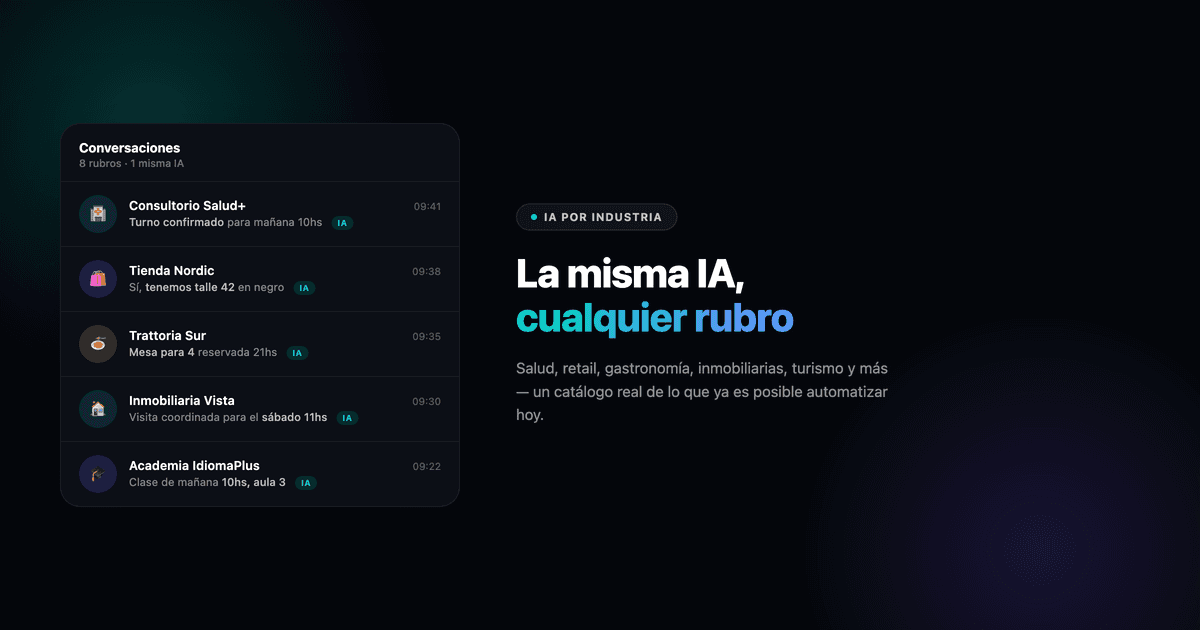
You don't need to be a "digital" business to implement this. The real requirement is having concrete information the AI can check — whatever shape your business takes:
- Physical stores (retail, apparel, hardware stores): stock inquiries, hours, location, and reserving a product for in-store pickup.
- Ecommerce: order tracking, abandoned cart recovery, changes and returns without generating a support ticket.
- Service businesses (agencies, consultancies, professional firms): initial inquiry screening, ballpark pricing, booking the first meeting.
- Any business built around appointments: healthcare, beauty and wellness, workshops, academies — scheduling, reminders and deposit collection, without anyone needing to be available to handle that specific message.
For a more detailed catalog of use cases by specific industry, we cover it in depth in AI for Customer Service by Industry.
Real examples of continuity across channels
What sets a well-implemented omnichannel system apart isn't answering well on each channel separately — it's holding the conversation together when the customer switches channels:
- A customer asks on WhatsApp whether a product is in stock. Two days later they visit the website, and the chat already knows they asked about that product, with no need to repeat the question.
- Someone books an appointment through the site widget and, needing to reschedule, calls by phone — the voice agent already has the appointment loaded and updates it on the spot, without asking for all the details again.
- An ecommerce order raises a shipping question; the customer tries WhatsApp first and, with no signal at that moment, calls instead — the answer is exactly the same information, with no contradictions.
What to consider before implementing this
- The quality of the connected data matters more than the AI model. An agent connected to outdated information will give outdated answers, no matter how advanced the underlying technology is.
- Define upfront when it hands off to a person. That's not a system failure — it's part of the design. The best agents know how to recognize when a case needs human judgment.
- Tone matters as much as information. An agent that answers correctly but doesn't sound like your business builds distrust. Tone gets trained with real examples, not a single generic instruction.
- Measure real usage and adjust. The first configuration is never the final one — your customers' real inquiries will surface adjustments no amount of upfront planning can anticipate.
Automatic, autonomous, and available 24/7
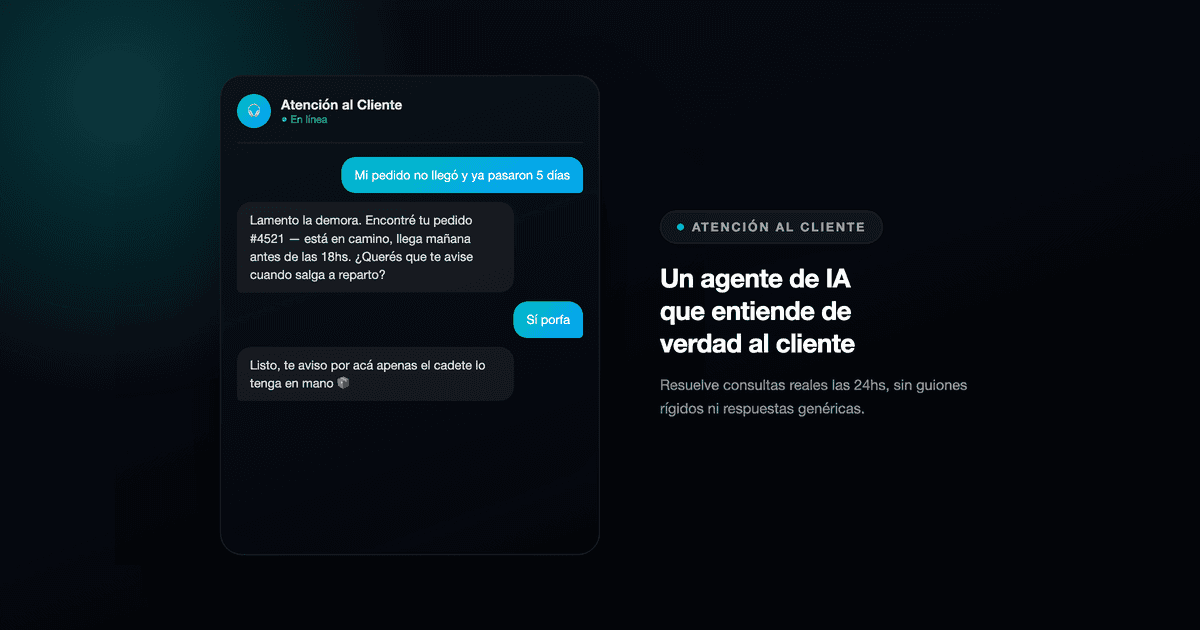
None of this depends on someone being available at the exact moment a customer writes or calls. The system runs on its own: it reads the message, checks the business's real information, responds or acts (books, charges, escalates) and stays available for the next customer a minute later — whether it's 1pm on a Tuesday or 3am on a Sunday.
That's what actually changes the customer experience: not that the answer is faster than a person's, but that a consistent answer exists at any moment, on any channel, without the business having to choose between having someone available around the clock or leaving inquiries unanswered.
At ALORA we design and implement AI customer care and experience systems tailored to each business — connected to WhatsApp, phone and web with the same brain behind all three. Tell us where your customer care is falling short today and we'll show you exactly how to fix it. Book a free 20-minute call.