
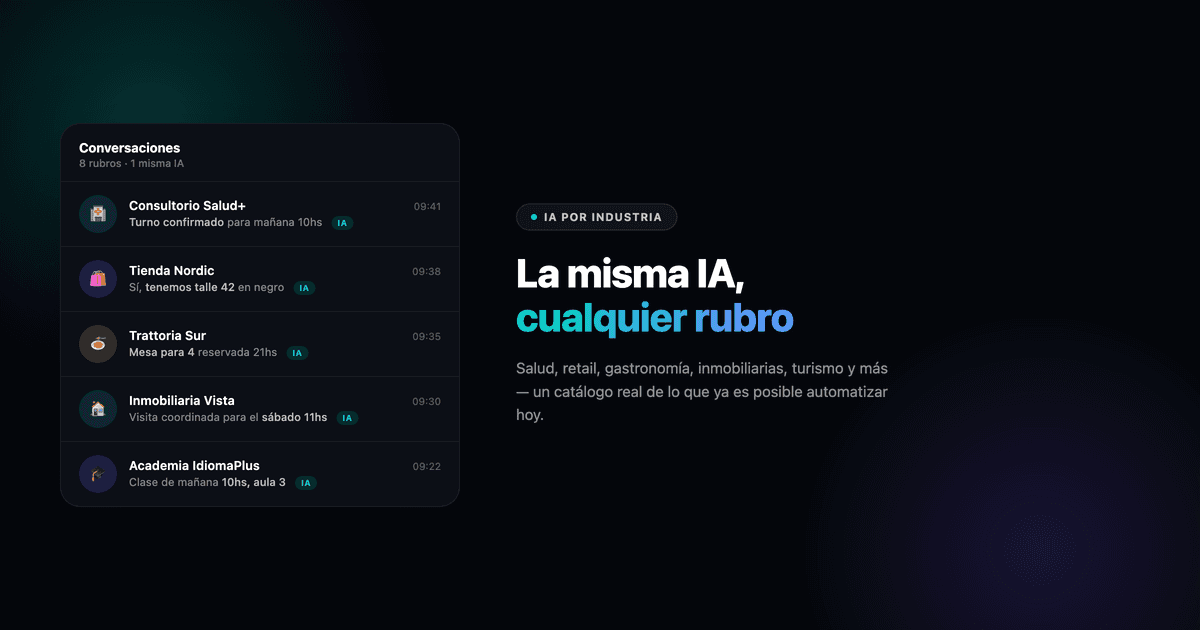
AI for customer service is no longer an experiment
A few years ago, "AI-powered customer service" sounded like a lab promise: bots that misread messages, generic replies, and a chat that always ended in "please contact an agent." That's changed. Today's conversational AI understands context, checks real-time business information, and resolves most inquiries without the customer ever noticing there isn't a person typing on the other end.
The question is no longer whether AI can be applied to your business's customer service. It's which part of your customer service you still haven't applied it to — because in practice, virtually every industry now has a concrete, accessible way to do it. That's the point of this article: not an abstract promise, but a sector-by-sector catalog of what's already possible.
What an AI agent actually does in customer service (quick recap)
Before going sector by sector, a quick clarification: an AI agent for customer service isn't a fixed-reply chatbot built on a decision tree. It reads the customer's message, understands the real intent, checks concrete business information (pricing, availability, appointments, stock) and responds or acts accordingly — booking, charging, escalating — with no pre-written script. If you want the full technical breakdown of how this works and how it differs from a traditional chatbot, we cover it in AI agent for customer service: what it is, how it works, and when it's worth implementing.
Here the focus is different: showing, with specific examples from every industry, what's possible to implement today.
AI for customer service, industry by industry
Healthcare and private practices
- 24/7 appointment booking over WhatsApp. The patient writes at any hour, the AI reads real calendar availability and confirms the appointment on the spot, with no one at the practice needing to be available to answer that message.
- Automatic deposit collection and reminders. The same agent requests and collects the deposit via Mercado Pago inside the conversation, and sends reminders 24 and 2 hours before to cut down on no-shows. This is exactly the mechanism we built into LIDIA, now in use at clinics and practices across Argentina, Uruguay, Spain and Chile.
- Initial inquiry triage. Before routing to a professional, the AI can rank the urgency of a message and direct it to the right person, instead of everything landing in the same unprioritized inbox.
Retail and physical stores
- Real-time stock and availability inquiries. "Do you have size 9 in black?" gets answered instantly, connected to the real inventory system, without a salesperson having to physically go check.
- Recommendations based on what the customer already asked. If someone asked about a product and didn't buy, an automated flow can pick the conversation back up with related options or a targeted promotion, with no one needing to remember to follow up.
- In-store pickup reservations. The customer reserves a product over chat and the system automatically holds the stock until they come pick it up.
Ecommerce
- Order tracking without a human in the loop. "Where's my order?" is one of the most common questions for any online store — and one of the easiest to resolve with AI connected to the shipping system, without generating a support ticket.
- Abandoned cart recovery over WhatsApp. Instead of a generic email nobody opens, a conversational message that answers specific questions (size, shipping, payment method) before the customer decides not to buy.
- Post-sale support and returns. Questions about exchanges, returns or warranty handled according to the business's actual policy, available outside human support hours.
Restaurants
- Reservations and orders over WhatsApp with no host or counter staff involved. The customer books a table or places a pickup order, and the system confirms based on real availability at that moment.
- Automatic answers about the menu. Frequent questions — gluten-free options, vegetarian dishes, allergens, hours — answered instantly, at any time, without interrupting the team during peak demand.
- Reservation reminders. Cuts down on no-shows the same way a medical practice reduces missed appointments: with an automatic reminder hours in advance.
Real estate
- Pre-qualifying interested buyers or renters. The AI answers questions about a listing (price, square footage, fees, viewing availability) and only escalates to a human agent once the interested party is genuinely qualified to move forward.
- Automatic viewing coordination. Instead of manual back-and-forth over WhatsApp to find a time, the system proposes and confirms viewing slots based on the agent's or property's real schedule.
- Cold lead follow-up. People who inquired weeks ago and went quiet get an automatic re-engagement message when a similar property to the one they asked about comes up.
Professional services (law firms, consultancies, agencies)
- Initial inquiry filtering before the first meeting. The AI answers frequent questions about services, ballpark fees and the work process, so the first human call already starts with a qualified lead.
- Booking the discovery call. The same mechanism we use at ALORA ourselves: a conversational agent coordinates the first call without manual back-and-forth over availability.
- Status updates for active clients. Questions like "what stage is my project at?" get answered by connecting the AI to the firm's real management system, instead of the client having to message one specific person.
Tourism and hospitality
- Real-time availability and rate inquiries. Before and during a stay, guests can ask over WhatsApp without depending on front-desk hours.
- Assisted check-in and check-out. Arrival information, access instructions and timing sent automatically, cutting down on repetitive questions to the front-desk team.
- Personalized local recommendations. The AI responds with real business information (tours, restaurants, transfers) without the guest having to wait for someone to be available at the desk.
Education (institutes, academies, courses)
- Enrollment information available all day. Questions about plans, schedules, pricing and format answered instantly, at the exact moment a prospective student is deciding — not 12 hours later.
- Class reminders and payment due dates. Cuts down on absenteeism and late payments the same way it cuts down on missed appointments in healthcare: by warning before it happens, not chasing after.
- Support for active students. Frequent questions about the platform, materials or schedule answered without depending on a coordinator being available at that exact moment.
What all of these cases have in common
Not a single example on this list is science fiction, and none of them depends on a "digital-first" industry. The same pattern repeats across all eight sectors: the AI reads a real message, checks real business information (a calendar, stock, rates, a project's status) and responds or acts accordingly, without a person needing to be available at that exact moment for the customer to get an answer.
That's what makes "all of this is possible" more than a marketing line: the underlying technology is the same in every case — an AI agent or a smart chatbot connected to your business's real information. What changes between industries isn't whether it's possible, but which information needs connecting and which decisions the AI needs to make in your specific case.
How this gets implemented in your business
The process is the same regardless of industry:
- Map the most frequent, repetitive inquiries — the ones currently eating up your team's time without requiring real human judgment.
- Connect the AI to real business information: calendar, stock, rates, management system — not a generic, outdated database.
- Define when it escalates to a person. No well-implemented case replaces human service 100% — it frees people from the repetitive part so they can focus on what genuinely needs judgment.
- Measure and adjust based on real usage, instead of sticking with the first configuration.
At ALORA we build both guided-flow chatbots and custom conversational AI agents tailored to each business — and the same approach we applied in healthcare with LIDIA carries over into ALORA CRM, which centralizes WhatsApp, chatbot and web-form leads into a single pipeline. Tell us your industry and we'll show you exactly what on this list applies to your business, no generic promises. Book a free 20-minute call.