
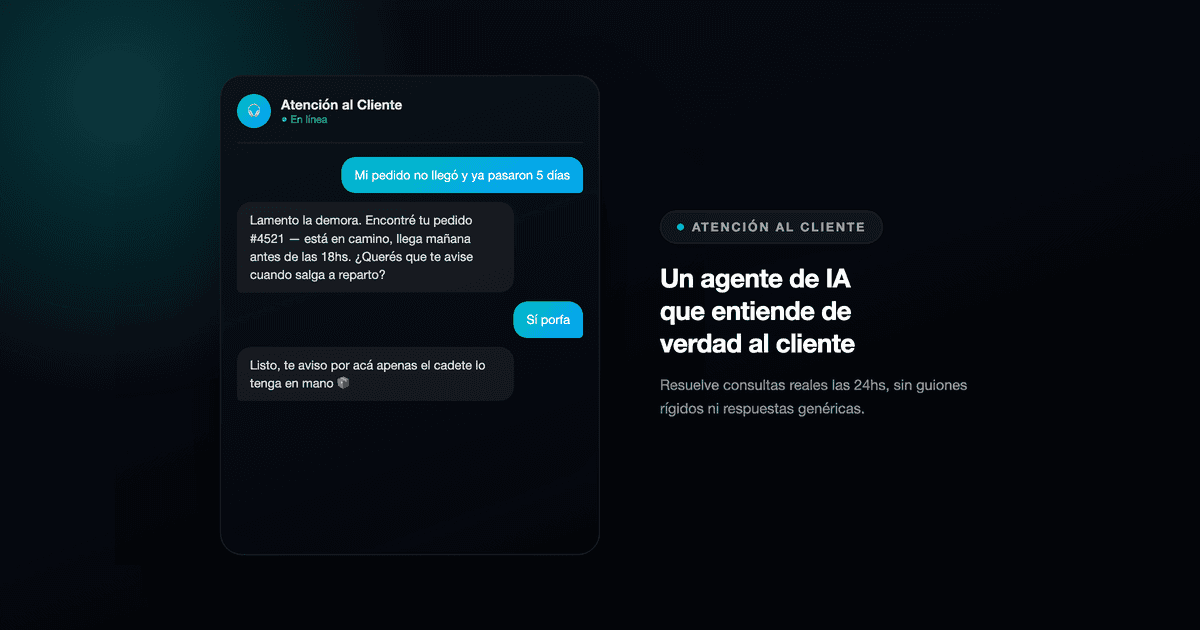
What is an AI agent for customer service?
An AI agent for customer service is an artificial intelligence system trained on a business's real information that can handle inquiries, solve problems, and make simple decisions autonomously, without human intervention.
Unlike a decision-tree chatbot — which follows fixed flows — an AI agent understands natural language, can answer questions that weren't pre-programmed, and reasons to offer the most appropriate response based on context.
The practical difference: a classic chatbot doesn't know what to answer if the question doesn't exactly match its programmed flows. An AI agent can understand "I want to know if you have something for the issue I had last week" even if that exact question was never programmed.
Traditional chatbot vs. AI agent: the real differences
| Capability | Traditional chatbot | AI agent |
|---|---|---|
| Language understanding | Exact keywords | Complex natural language |
| Possible responses | Only pre-programmed ones | Any question within the domain |
| Conversation memory | No context | Maintains thread context |
| Handling ambiguity | Escalates to human or fails | Asks for clarification and continues |
| Updates | Manual reprogramming | Knowledge base updates |
| Implementation cost | Low | Medium-high |
| Best for | Simple FAQs and linear processes | Real support and complex inquiries |
What can an AI agent do? (and what it can't)
What it can do:
- Answer questions about products, pricing, policies, and the purchase process.
- Classify the customer's issue and route it to the right department.
- Handle simple data changes (shipping address, contact preference).
- Gather information to speed up subsequent human support.
- Resolve 60-80% of frequent inquiries without escalating.
- Operate in parallel across multiple conversations at no additional cost.
What it can't do (yet):
- Make decisions that require deep empathy or complex human judgment.
- Resolve emotional conflicts with very upset customers (though it can contain the situation and escalate).
- Access internal systems without the right integration (CRM, ERP).
- Guarantee total accuracy with poorly documented information.
- Fully replace human agents in high-complexity cases.
The channels where an AI agent works
- WhatsApp Business API (the most effective in Latin America due to penetration)
- Website chat (embedded widget)
- Instagram Direct and Facebook Messenger
- Email (classification and automatic response)
- Slack or Teams (for internal customer support)
Real metrics from companies with active AI agents
Data from real implementations: resolution rate without escalating to a human: 65-75%. Average first-response time: from 4 hours to 2 minutes. Customer satisfaction (CSAT): no negative change in 80% of cases when the agent is well trained.
The factor that most impacts results isn't the AI model chosen, but the quality of the training. An agent trained on generic documentation responds generically. An agent trained on the business's real processes, policies, catalog, and tone responds as if it were part of the team.
How an AI agent is trained with your business's information
The training process has three main sources:
- Structured knowledge base: frequently asked questions, pricing, policies, processes, and product/service catalog. The more complete, the better the agent.
- Historical conversations: the real inquiries you've received in the past are the best training material. They let the agent learn the patterns of what your customers actually ask.
- Personality and boundary instructions: how to talk (formal/informal), which topics it can answer, and when to escalate. This defines whether the agent feels like part of the brand or like a generic bot.
When does it make sense to implement an AI agent, and when not?
It makes sense when:
- You receive more than 50 repetitive inquiries per week.
- Current response time exceeds 30 minutes.
- Your team spends more than 2 hours a day answering basic questions.
- You want to provide support outside business hours without hiring night staff.
It doesn't make sense (yet) when:
- The business is very small and inquiries are few and highly personalized.
- There's no basic business documentation (without documentation, there's nothing to train on).
- The sales process requires a very close human relationship from the first contact.
At ALORA we design and implement AI agents for customer service trained on your business's real information. If you'd like to evaluate whether it's the right time for your company, let's talk.