Web applications thatdigitize and scaleyour business
We design and develop custom web applications and software systems — from internal tools to SaaS platforms — built to solve real problems and grow with you.
What is a web application?
Before building, it's worth understanding what a web application is and isn't, and why it's usually the most flexible option to digitize your business.
A tool that runs in the browser, not in an app store
A web application (or web app) is a system that runs directly from the browser, with no installation required. It's designed by first understanding the real problem it needs to solve, a workflow, a management process, an operation, and then building the architecture, database and interface that make it possible.
Native apps, PWAs and web applications: not the same thing
App Store / Google Play
Installed from an app store. Accesses device features, but requires Apple or Google approval, maintaining two versions (iOS and Android), and updates that depend on the user installing them.
Progressive Web App
A website that can be "installed" as an icon on your phone. Works partially offline and doesn't depend on an app store, but has limited access to native device features.
What we build at ALORA
Runs 100% in the browser, no installation. Updates instantly for every user and is accessible from any device. Ideal for internal tools, portals and management platforms.
Systems built for your operation, not a template
Software systems designed to support growth, complexity and real operations.
Internal management systems
Custom software for operations, logistics, finance and internal workflows.
Client or partner portals
Platforms for clients and partners to interact with your business and self-manage information.
SaaS products and platforms
Products designed for external users, built with scalability and growth in mind.
Admin panels and dashboards
Full control over data, users and operations from a single place.
API-driven architectures
Systems built for integrations, flexibility and long-term technical evolution.
Design centered on the problem, not just the technology
We don't start with the tech stack. We start by understanding the real problem your business needs to solve and how your team works. Every architecture, flow and interface decision responds to that, so the system doesn't just function, it actually gets used.
Focus on your business and real operation
Architecture and flows adapted to how your team works, not a generic mold.
Optimized for SEO, GEO, AIO and LLM
When relevant, built to rank in search engines and AI engines alike.
Self-manageable systems
Your own panels and controls to manage your system without depending on us.
AI-first development
We combine solid engineering practices with AI-accelerated workflows to build software faster.
What web applications are used for
What our web application service includes
Diagnosis and problem definition
We understand your business's real process before writing a single line of code.
Flow design and real user experience
We design screens and flows built for how your team actually works, not a generic mold.
Scalable, maintainable technical architecture
We define a solid foundation so the system can grow without being rewritten.
Development with modern technology
We build with good practices and technology meant to last and evolve.
Admin panel and full control
We give you the tools to manage data, users and operations yourself.
Integrations with existing tools
We connect the system with what you already use: CRM, ERP, payments, communications.
Testing, security and validation
We test every flow and validate security and performance before launch.
Post-launch support and evolution
We stay close after launch to adjust and add real features.
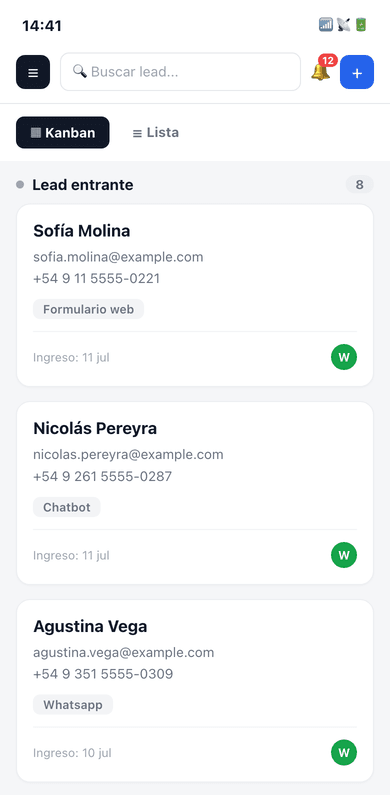
A web CRM that works just as well on mobile as on desktop.
We designed and built ALORA CRM, a fully responsive sales management web app: pipeline, lead cards and WhatsApp with built-in AI, working the same on desktop and mobile. Now available as a white-label product for other companies.
A web application built by people who understand business, not just code
We don't just write code. We build digital tools that solve real problems and grow your business.
Every decision responds to solving a real problem, not a trend
Agile processes, no unnecessary detours or delays
Direct communication with the team building your system
Solid, maintainable code that's ready to scale
Full control handed to you to manage your system
We stay close after launch, we don't disappear
What people who've worked with us say
Working with Alora was an excellent experience. They developed both our institutional website and a fully custom professional ranking system, which now lets us manage players, statistics and points clearly and efficiently. The platform is fast, easy to use, and gave our table tennis organization a real leap in quality. There was always good communication, commitment and willingness to adapt the system to our real needs.
At Fundación por Nuestros Niños we're grateful for the process we shared in creating our website. It's been a wonderful experience that also let us revisit some very important aspects of our organization. It was a pending debt for our NGO, which has worked for more than 28 years for the children of Salta. Thank you for the warmth, commitment, professionalism and patience of the Alora team. We hope to keep our alliance for the common good!
It was a pleasure working with Bruno and his team — the processes and communication channels, how they managed timelines, and the seriousness with which they approached the work. They took the time to understand the essence of the project, made relevant suggestions, and were always willing to resolve any situation. I was very happy with the work delivered and I recommend them.
During this time, the work was very professional, with great responsiveness and on-time delivery. Communication was always clear and effective. I'd highlight the commitment and efficiency.
How we work
A clear, connected and measurable method at every stage.
Discovery call
A first call to learn about your project, your business and what you need to achieve.
Business analysis
We understand real objectives, context and priorities. This defines what the application must achieve and which metrics we'll move.
Architecture and focus
We turn objectives into technical structure and scope. We prioritize features, integrations and criteria before development.
Experience and flows
We design the interface and flows that guide the user. We prototype screens ready to validate with your team.
Development and QA
We build with maintainable code and testing at every iteration. We integrate APIs, security and performance before launch.
Launch and continuous improvement
We support the rollout to production and real-world adjustments. We measure behavior and plan evolutions together with your team.
We work with clear processes, direct communication and only the steps needed to achieve real results.
Frequently asked questions
What does ALORA's Web Applications service include?
Does it integrate with the tools I already use (CRM, calendar, booking system)?
What happens if the AI can't resolve a query?
Why choose ALORA for Web Applications?
How much does Web Applications service cost?
Should we talk about your web application?
Let's set up a brief call to understand your project and see how we can help you build it.
Tell us about your project
Tech insights you might like
What is a CRM and why your business needs one (with examples and AI included)

Your Competitors Are Already Using AI to Sell More. You're Still Using It to Write Captions.