
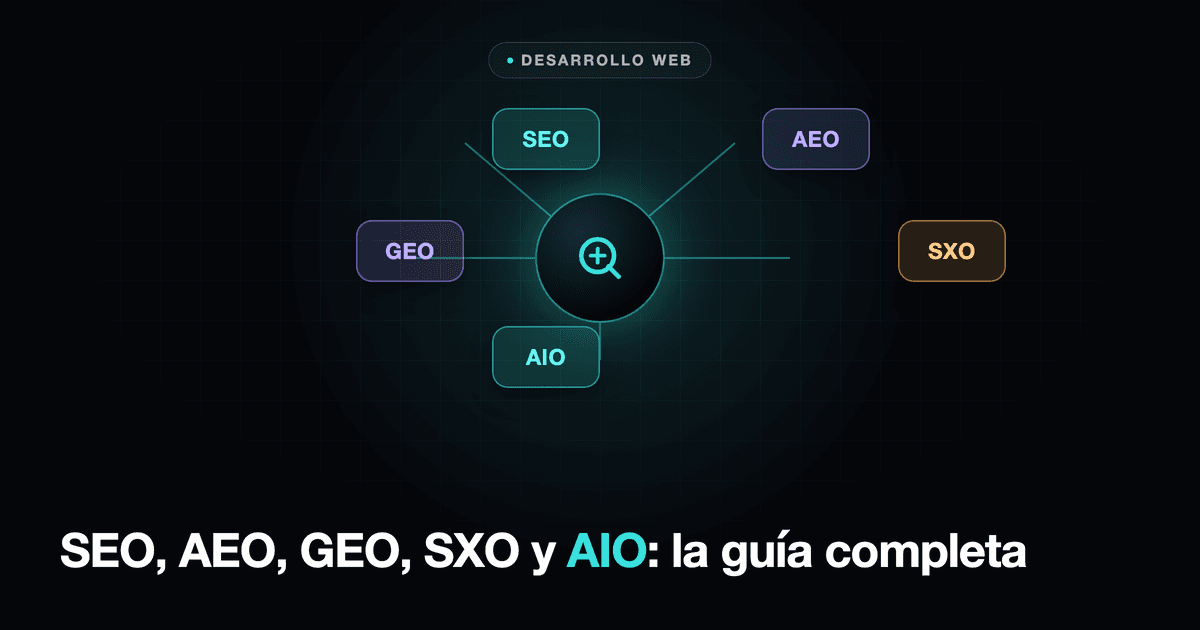
Five acronyms, one question: how do people find you on Google and on AI today?
A few years ago, "being on Google" was enough. Today someone can find your business five different ways: searching Google the classic way, reading the AI summary Google puts above the results (AI Overviews), asking ChatGPT, Gemini, Claude or Perplexity directly, using a voice assistant, or landing on a page that loads slowly and leaving before reading anything. Each of those five ways has its own modern SEO discipline — and the five acronyms in the title are, quite simply, those five ways.
They don't compete with each other. None of them "replaced" the others. They're layers that coexist today, and a well-built site needs all five.
What is SEO (Search Engine Optimization) and why it's still the foundation of ranking on Google
SEO (Search Engine Optimization) is the original discipline: making sure a traditional search engine — Google, Bing — can find, understand and rank your site well. It covers the technical side (an up-to-date sitemap, canonical URLs, complete metadata, load speed) and the structural side (a clear heading hierarchy, internal links connecting related content, no orphaned pages).
It's the foundation because the other four disciplines depend on this being solid first. A site with broken canonical URLs or no sitemap has no way to perform well at any of the layers above it.
What is AEO (Answer Engine Optimization) and how to show up in Google's featured snippets
AEO (Answer Engine Optimization) means optimizing so your content becomes THE direct answer to a question, not one of ten links for the user to pick from. It applies to Google's featured snippets, to voice assistant answers, and to any interface trying to give a single answer instead of a list.
The concrete way to work on AEO is content in explicit question-and-answer format, with FAQPage structured data telling the search engine "this specific question has this specific answer," and short, quotable definitions at the start of each section — not a paragraph of context before you get to the point.
What is GEO (Generative Engine Optimization) and how to get cited by ChatGPT, Perplexity and Google's AI Overviews
GEO (Generative Engine Optimization) is the newest of the five, and the one most businesses still understand the least. It's about optimizing so tools like ChatGPT, Gemini, Claude, Perplexity or Google's AI Overviews mention or cite you when someone asks them something related to what you do — each of these generative AIs crawls and prioritizes information differently, but they all reward the same thing: clear, verifiable, well-structured data.
Unlike classic SEO, there's no ranking of ten positions here — either you get cited, or you don't exist in that answer. What improves your odds: content with specific, verifiable facts (not generic claims), complete structured data (Organization, Service, Article), and consistency — if your site says one thing on one page and something different on another, a generative model has no way to know which is true, and when in doubt, it won't cite you.
What is SXO (Search Experience Optimization) and why mobile site speed affects your ranking too
SXO (Search Experience Optimization) merges SEO with user experience: it's not enough for someone to REACH your site, they have to stay, understand, and move forward. Google measures this with Core Web Vitals — concrete metrics like LCP (how fast the main content appears) and INP (how fast the site responds when someone interacts with it) — and penalizes sites that fail there, even when the content itself is good.
In practice, it's the easiest discipline to accidentally wreck: a misconfigured analytics script, an unoptimized image, or a menu that's slow to open on mobile can cost you rankings you earned with good content.
What is AIO (AI Optimization) and how to optimize your site so AI systems understand it
AIO (AI Optimization) is the broadest of the five: making sure any AI system — an assistant, an agent, another company's internal tool — can read, interpret and correctly use your site's information. It rests on complete, consistent structured data, semantically clear content, and specific tools like the llms.txt file, built exactly for this purpose — we cover it in detail in what llms.txt is and why your site needs it.
SEO vs AEO vs GEO vs SXO vs AIO: how they differ and why they don't compete
Here's the point most people get wrong: you don't "pick" a discipline. A well-built FAQPage serves AEO (featured snippets) and GEO (it gives a generative model a clear, quotable answer) at the same time. A complete, accurate Organization schema helps classic SEO, GEO and AIO simultaneously. A fast mobile site improves SXO directly and, as a result, classic SEO too, since Google uses speed as a ranking signal.
Working on all five isn't five times the work — it's mostly the same work done well, with all five audiences in mind at once: a traditional search engine, an answer box, a generative model, a real user, and an AI interpreting your site for some other reason entirely.
| Discipline | What it optimizes | Where it shows up | How you achieve it |
|---|---|---|---|
| SEO | Ranking on traditional search engines | Google, Bing results | Metadata, speed, internal links |
| AEO | Being the direct answer | Google featured snippets, voice assistants | Q&A-format content, FAQPage schema |
| GEO | Getting cited by generative AI | ChatGPT, Gemini, Claude, Perplexity, AI Overviews | Structured data, consistent verifiable facts |
| SXO | Real user experience | Any device, especially mobile | Core Web Vitals: LCP, INP, speed |
| AIO | Any AI correctly interpreting your site | Assistants, agents, third-party tools | llms.txt, semantic HTML, complete schema |
SEO, AEO, GEO, SXO and AIO checklist: what to check on your site step by step
SEO
- Up-to-date sitemap.xml with no broken URLs
- Every page with a unique title and description (not too short, not so long Google cuts them off)
- One
<h1>per page, with a clear subheading hierarchy - Internal links between related content, no orphaned pages
AEO
- Real frequently asked questions, with
FAQPagestructured data - Short, direct definitions at the start of each key section
- Answers that make sense read on their own, without the rest of the article's context
GEO
- Complete structured data:
Organization,Serviceon your product/service pages,Articleon the blog - Consistent information across the whole site — the same address, the same contact details, everywhere
- Content with specific, verifiable facts, not generic marketing claims
SXO
- Measure real Core Web Vitals (not just eyeballing the design on a laptop) — test on a mid-range phone on a slow connection
- Check which third-party scripts (analytics, pixels) are loading, and at what priority
- Confirm menus, forms and buttons work well on mobile, not just desktop
AIO
- Keep an up-to-date
llms.txtfile reflecting the site's real structure - Avoid contradictions between pages — an AI that detects inconsistent information loses trust in the whole site, not just that page
- Semantic HTML: use the tags that actually match each type of content, not a generic
<div>for everything
How to audit SEO, AEO, GEO, SXO and AIO: a real example from our own site
This isn't abstract theory — it's literally what we just audited on globalalora.com. Among other things, we found and fixed: an Organization schema claiming a single headquarters when we actually have a base in three countries, meta descriptions that were too short on some pages (wasting the space Google gives a result) and too long on others (cut off mid-sentence), and a real mobile speed problem caused by giving an analytics script the wrong load priority.
That's the central point of all five disciplines: they're not a checklist you complete once. They're an audit you repeat, because a living site — one that publishes new content, adds pages, changes third-party providers — drifts out of alignment over time if nobody checks.
Want to know where your site stands across these five dimensions? Book a free 20-minute call and we'll tell you, with no generic promises, what we'd find.