
Two types of AI that solve opposite problems
"Generative AI" and "predictive AI" get used as if they were the same thing with different names. They're not, and mixing them up leads to bad decisions: you ask for a chatbot when what you actually need is a demand-forecasting model, or you commission a forecasting project when what your business needs is automating WhatsApp replies.
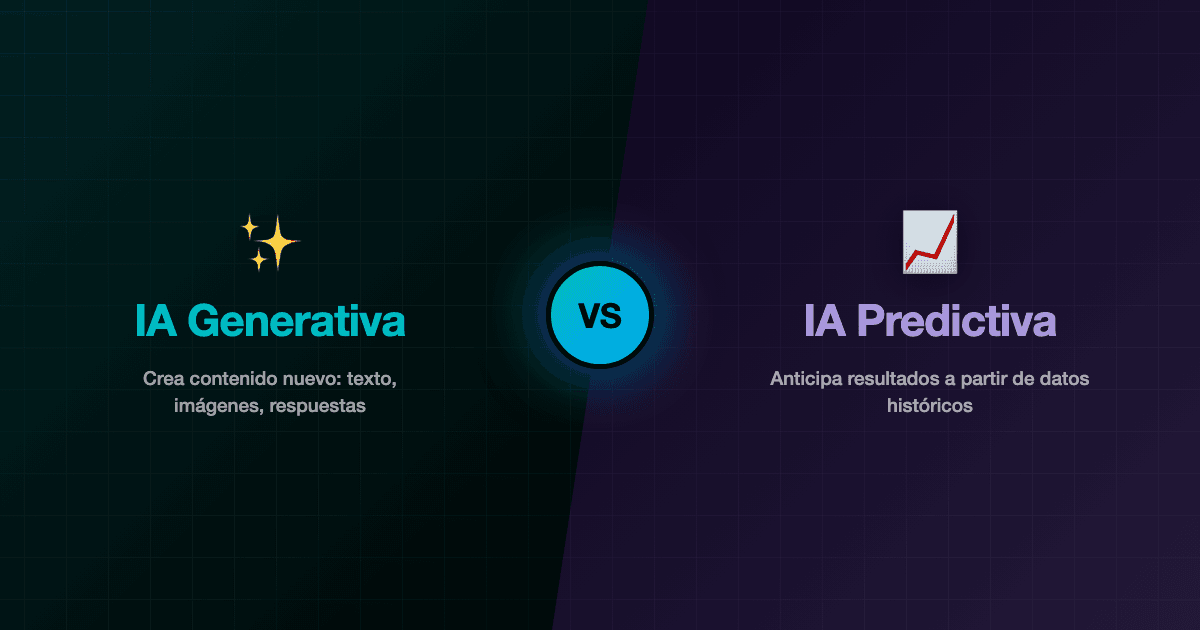
The difference is fundamental: generative AI creates new content, predictive AI anticipates an outcome from historical data.
What is generative AI?
Generative AI takes an instruction (text, image, audio) and produces new content that didn't exist before: text, images, code, voice, video. It runs on large language models (LLMs) or diffusion models, trained on huge amounts of data to learn patterns and produce original outputs.
Examples you're probably already using:
- ChatGPT, Claude, Gemini: generate text — replies, summaries, drafts, code.
- Midjourney, DALL-E: generate images from a description.
- A WhatsApp chatbot or conversational agent (like the ones we build at ALORA): generates the reply to each customer inquiry, in real time.
What defines generative AI:
- Produces something new every time, instead of picking from fixed options.
- Isn't deterministic: the same question can get different (though consistent) answers.
- Applies to unstructured content: free text, images, conversations.
What is predictive AI?
Predictive AI doesn't generate anything new — it analyzes historical data to anticipate a future outcome or classify something. You feed it structured data (past sales, customer behavior, machine sensors) and the model learns patterns to predict what's going to happen or which category a new case falls into.
Business examples:
- Demand forecasting: how much you'll sell next month, by product and by location.
- Lead scoring: how likely a lead is to convert into a customer (HubSpot and Salesforce Einstein offer this).
- Fraud detection: whether a transaction is likely fraudulent, in real time.
- Predictive maintenance: when a machine is going to fail, before it fails.
- Stock prediction: which products are going to run out before it happens.
What defines predictive AI:
- Doesn't create content: it returns a number, a probability, or a category.
- Depends on quality, structured historical data — without a good track record, there's no good prediction.
- Is deterministic within its model: the same input data produces the same prediction.
The real difference, point by point
| Generative AI | Predictive AI | |
|---|---|---|
| What it produces | New content (text, image, voice) | A result, probability, or category |
| Question it answers | "What should I say or create?" | "What's going to happen?" |
| Type of data | Unstructured (text, conversations) | Structured and historical (sales, transactions) |
| Examples | ChatGPT, Claude, Midjourney, chatbots | Demand forecasting, lead scoring, predictive maintenance |
| Output | Different each time, consistent | Same input, always the same output |
| Main risk | Can "hallucinate" incorrect information | Only as good as the historical data feeding it |
When does generative AI make sense for your business?
It makes sense when you need to:
- Answer customer inquiries over WhatsApp, web chat, or email, without a human typing every reply.
- Generate content repeatedly: product descriptions, emails, posts.
- Automate writing tasks: quotes, meeting summaries, proposals.
When does predictive AI make sense for your business?
It makes sense when you need to:
- Anticipate demand or sales so you don't run out of stock or overstock.
- Prioritize leads by real purchase probability, not by order of arrival.
- Detect risk before it happens: a customer about to churn, a suspicious transaction, equipment about to fail.
Real example: same business, two different problems
Think of a wholesale ecommerce business (one of the industries we work with at ALORA). Two typical problems:
Problem 1: they don't know a product is about to run out until it already has. Here the solution is predictive AI: a model that looks at sales history, seasonality, and restocking lead time, and flags in advance which product needs restocking and when.
Problem 2: wholesale customers ask over WhatsApp about pricing, availability, and order status, and the team can't keep up. Here the solution is generative AI: a conversational agent that replies in real time, using real data from the management system.
Two different projects, different technology, solving the same business.
Can you combine both?
Yes, and it's increasingly common. A typical case: predictive AI detects that a lead has a high probability of buying, and generative AI writes the personalized follow-up message for that specific lead. One decides who to prioritize, the other executes the communication. Neither replaces the other — they solve different parts of the same problem.
Conclusion
Neither one is "better" — they answer different questions. If your problem is "I need to reply or create content faster," that's a generative AI case. If your problem is "I need to anticipate what's going to happen before it happens," that's a predictive AI case. Many businesses end up needing both, in different parts of their operation.
At ALORA we build conversational agents powered by generative AI and custom software that incorporates predictive models when the case calls for it. If you're not sure which one you need, book a free AI audit and we'll figure it out together, based on your actual operation.